
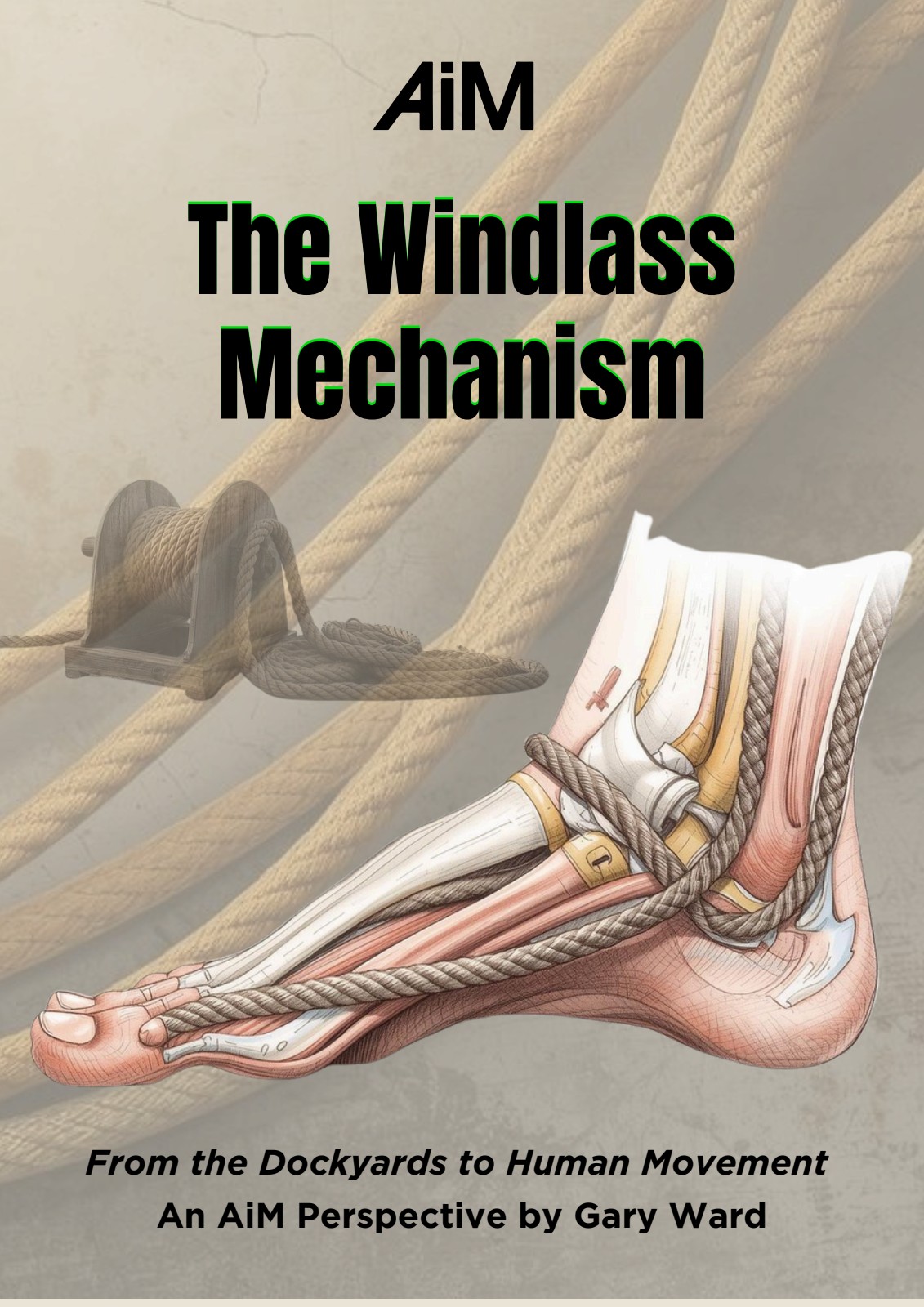
The Windlass Mechanism
From the Dockyards to Human Movement
Challenge the industry's narrow view of pronation. Discover why the Windlass Mechanism offers insight into the organisation of the whole body, the flow of movement through the gait cycle, and the role of the foot as a living, adaptive structure.
"Pronation is the highest-value movement in the human body"
— Gary Ward
Challenge Industry Narratives
Understand why 'over-pronation' has been misrepresented and discover the truth about pronation's role in human movement.
3D Understanding
Move beyond traditional 2D biomechanical models to see how the Windlass operates as a whole-body rhythm.
Practical Self-Assessment
Learn the Active, Passive, and Reverse Windlass tests you can use immediately with clients or on yourself.
Whole-Body Perspective
Discover how foot mechanics influence the entire kinetic chain—from pelvis to spine to head.
What's Inside
Detailed Table of Contents
History & Origins
J.H. Hicks' 1954 discovery and the dockyard windlass analogy
The 3 Types of Windlass
Active, Passive, and Reverse Windlass mechanisms explained
Gary's Journey
From orthotics to discovering the full story of the Windlass
The AiM Perspective
Why pronation is not evil—and why the industry got it wrong
Self-Assessment Tests
Active Windlass Test, Passive Windlass Test, and Reverse Windlass
The 60-Degree Rule
The precise mechanics that make or break efficient propulsion
Windlass as Whole-Body
How posture, pelvis, and spine affect your toe function
Practical Exercises
Restore natural organisation of bones and joint motion
Preview
Excerpts from the Ebook
The Dockyard Analogy
"A windlass is a rotating drum, axle or fulcrum used to hoist anchors and heavy loads by winding a rope around it. Lift a 100kg weight with a straight rope = 100kg effort. Wrap it over one fulcrum = the load reduces to 50kg. Wrap it around two fulcrums = the load drops to 25kg."
The Industry's Blind Spot
"The Windlass got reduced to a measuring stick for how much a foot pronates, and orthotic design became obsessed with minimising over-pronation. Somewhere along the way, pronation was cast as 'evil,' much like 'weak glutes' or 'lazy TVA muscles.' None of those narratives hold up as truth."
The 60-Degree Rule
"For the Windlass to function optimally, the first metatarsophalangeal joint requires a combined angle of 60° hallux dorsiflexion: 40° from the big toe extension and 20° from the first metatarsal plantarflexion. Anything less or more compromises the body's movement response."
Who Is This For?
This ebook is designed for movement professionals who want to go beyond traditional orthotic thinking and understand the Windlass Mechanism from a whole-body perspective.
If you've ever questioned why "fix the pronation" doesn't always work, or wondered why strengthening "sleepy glutes" yields inconsistent results—this ebook will provide the answers.
Ready to Transform Your Understanding?
16+ pages of in-depth, practice-changing content from Gary Ward's 25 years of mapping human movement through the Flow Motion Model.
Comments are closed.