
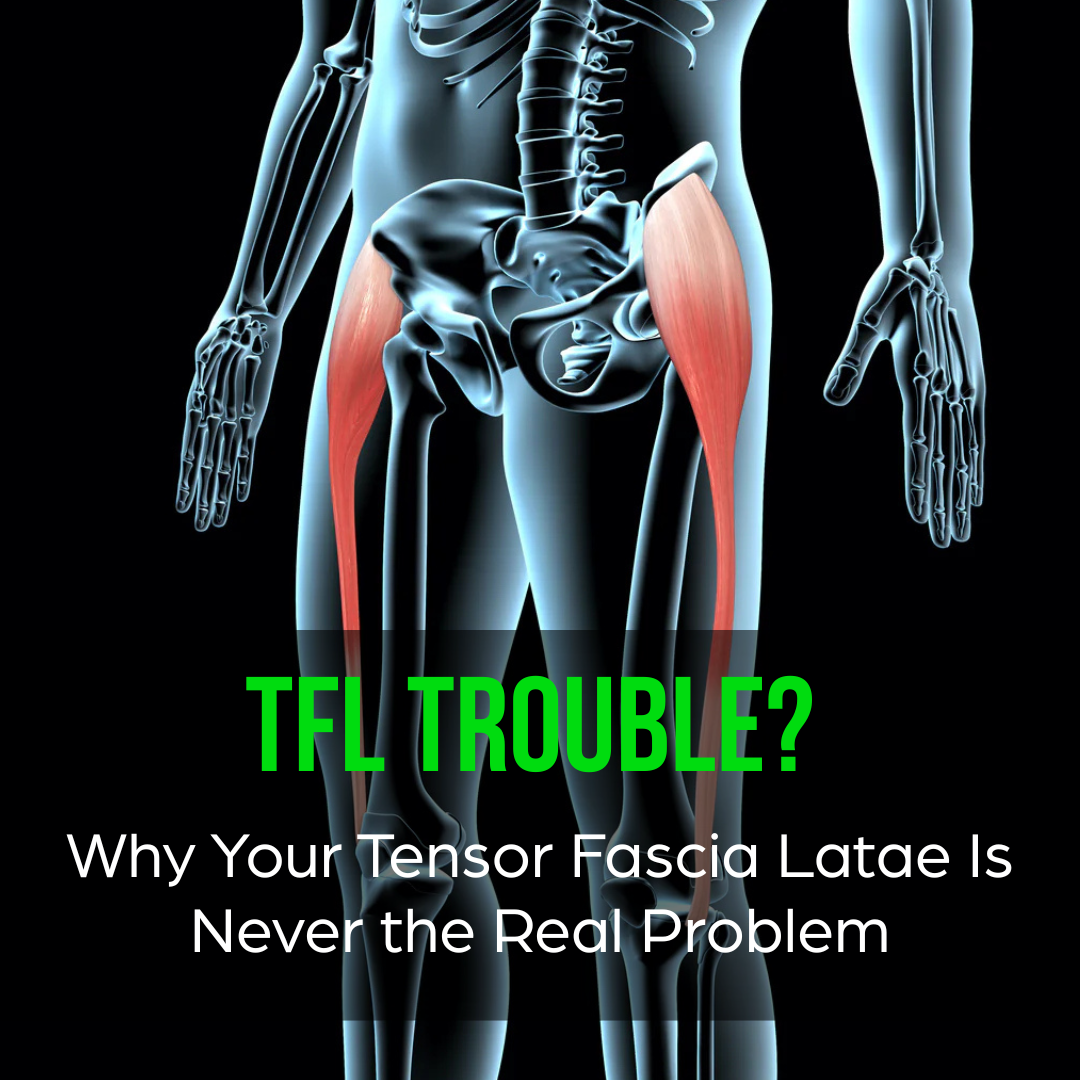
The Tensor Fascia Latae (TFL) isn’t a new type of coffee, it’s a small but powerful muscle on the front-side of your pelvis that connects into the long tendon we know as the ITB. Despite its size, it gets blamed for a lot of discomfort, especially in runners.
People poke it, stretch it, roll it, curse it… and as my friend Helen Hall once said, “Stop beating the living sh!t out of it and learn how to use it!”
The TFL doesn’t need abuse… It needs movement.
Why the TFL Reacts: A Quick AiM Breakdown
At AiM we always return to two principles:
- Muscles lengthen before they contract.
- Joints act; muscles react.
Your TFL reacts to the behaviour of the pelvis, hip, knee, and foot. Because the muscle’s tendon runs all the way to the lateral tibia, it’s influenced by every movement your leg makes — and every movement it fails to make.
How the TFL Actually Works
- Sagittal plane: Shortens with anterior pelvic tilt → hip flexion
- Frontal plane: Shortens when the pelvis drops/shift away → hip abduction
- Transverse plane: Its real job is to pull the hip from external rotation back to neutral
In gait, this transverse action should happen when the foot is resupinating — not pronating. If your foot stays pronated, your hip’s rotational rhythm never completes, and the TFL stays long, tense, and reactive.
This is the beginning of the “TFL/ITB syndrome” story.
The Real Culprit: The Pronated Leg Shape
Foot pronation itself is not a problem.
Getting stuck in it is.
A chronically pronated leg shape typically brings:
- Knee flexion
- Femur internal rotation
- Hip external rotation
- Pelvic hike
All of this winds up the TFL–ITB system. The muscle is designed to decelerate motion into pronation. But when the motion is:
- too fast
- too extreme
- or never completed with good supination
…then the TFL never gets to shorten. It lives in tension.
Most people simply don’t have access to:
- Knee extension
- Femur external rotation
- Hip internal rotation
- True foot supination
And so the TFL keeps shouting for help.
Why Strengthening or Stretching Rarely Helps
Google will offer “3 stretches for your ITB” or “3 exercises for your TFL.”
But none of these matter if the foot, knee, hip, and pelvis can’t move well as a team.
Closed-chain movement is the missing link.
When your foot is grounded and working through pronation and supination on its tripod, the whole system starts to reorganise. The hip regains the ability to flex/extend, rotate, adduct/abduct — and the TFL stops living at the end of its tether.
This is exactly what we break down in the AiM Closed Chain Biomechanics courses and the Wake Your Body/Fee Up self-help programmes: restoring integrated motion so muscles can do their job without strain.
So What Do You Do About TFL/ITB Pain?
Not stretch it.
Not roll it.
Not attack it.
Instead:
1. Restore healthy pronation.
Not the collapsed kind — the coordinated, 3D version your body intended.
2. Restore healthy supination.
Most people never truly achieve a supinated leg shape. The TFL never experiences its shortening phase.
3. Let the hip regain its full 3D vocabulary.
Flex, extend, rotate, adduct, abduct — all of it matters.
4. Address the shape you’re stuck in.
If your discomfort is on the pelvic-hike side → teach the pelvis to drop.
If it’s on the pronated-foot side → teach the foot to supinate cleanly.
When the bones can move well, the TFL/ITB complex can finally relax.
The Bottom Line
The TFL isn’t the villain.
It’s doing its best to manage the shape you’re living in.
When you teach your feet, knees, hips and pelvis to move through pronation and supination the way they were designed to, the TFL stops complaining — because it finally gets to lengthen, shorten, and rest in that sweet spot we call centre.
If you’re dealing with TFL or ITB discomfort, the solution isn’t in hammering the tissue. It’s in restoring the movement that lets your body take the pressure off itself naturally.
3 Comments
So this problem might be closely related to big toe not working properly as the root of everything else?
Hey, if the big toe has limitations, it will 100% affect your foot and leg mechanics. Lack of big toe dorsiflexion for instance compromises the capacity to supinate your leg, which means more likely to rest pronated and increase tension in your TFL/ ITB
Love this. Brilliantly succinct and clear. Still baffles me that this isn’t the go to thinking and thought process that all therapists/trainers would look at